I want to share this with you, I find it interesting.
What's this?

That's the flag of a short-lived Greek island-state, Free State of Icaria.
Icaria is a small island nearby my island, Samos. It was named from Icarus who fell there into the sea (Icarian Pelago) when the wax of his wings melted.

You all know Icarus. If you don't, this might be of help.
Well, Icaria has been Greek for millenia, but as the rest of Greece and the Balcan peninsula it fell under Othoman rule for centuries.
According to Wikipedia:
"Icaria remained part of the Ottoman Empire until July 17, 1912, when the Icarians expelled a Turkish garrison and thereby achieved independence. After its independence and the outbreak of the First Balkan War, Icaria's sole "warship", the Cleopatra, was used to provide food and supplies to the islands of Samos and Chios, which were captured by the Greek Navy during the war.
George N. Spanos (c. 1872–1912) of Evdilos, killed in a Turkish ambush on July 17, 1912, is honored as the hero of the Icarian Revolution. His bust, depicting him defiantly, with bandoliers and rifle in hand, may be seen at the memorial established in his honor at the site of his death located in the Icarian town of Chrysostomos.
On July 18, 1912, the Free State of Icaria (Ελευθέρα Πολιτεία Ικαρίας, Elefthéra Politía Ikarías) was declared. The neighboring islands of Fournoi Korseon were also liberated and became part of the Free State. Ioannis Malahias (Ιωάννης Μαλαχίας) was the first and only president of the Free State of Icaria.
For five months, it remained an independent country, with its own government, armed forces,
national flag, coat of arms, postage stamps, and national anthem. These five months were difficult for the island's economy. There were food shortages and they were at risk of becoming part of the Italian Dodecanese. In November 1912, after a delay due to the Balkan Wars, Icaria officially became part of the Kingdom of Greece. Ottoman Empire recognized Greece's annexation of Icaria and the other Aegean islands in the Treaty of London (1913).
For some reason, the flag is identical to the flag of Switzerland, but with cyan color instead of red.
I have no information why they chose this flag but I think this wasn't on purpose, because they had nothing to do with Switzerland at the time. Instead, since the citizens were Greeks and their purpose was to become part of Greece again, they used the then Greek flag (at the time our contemporary flag was the maritime and commerce flag and a simple cyan flag with a cross the state and army flag) and in order to differentiate the flag from the Greek they used a Greek cross, as they did in Switzerland. The colors were identical to the ones on the Greek National Flag. The then Greek National Flag looked like the one of the Scandinavian states, with the cross extending to the border. In fact the 1821 revolutionary flag was identical to that of Finland, so aftewards the colors were reversed and gradually the cyan became darker.
Here is the Kolokotronis flag of 1821, similar to Finland's.

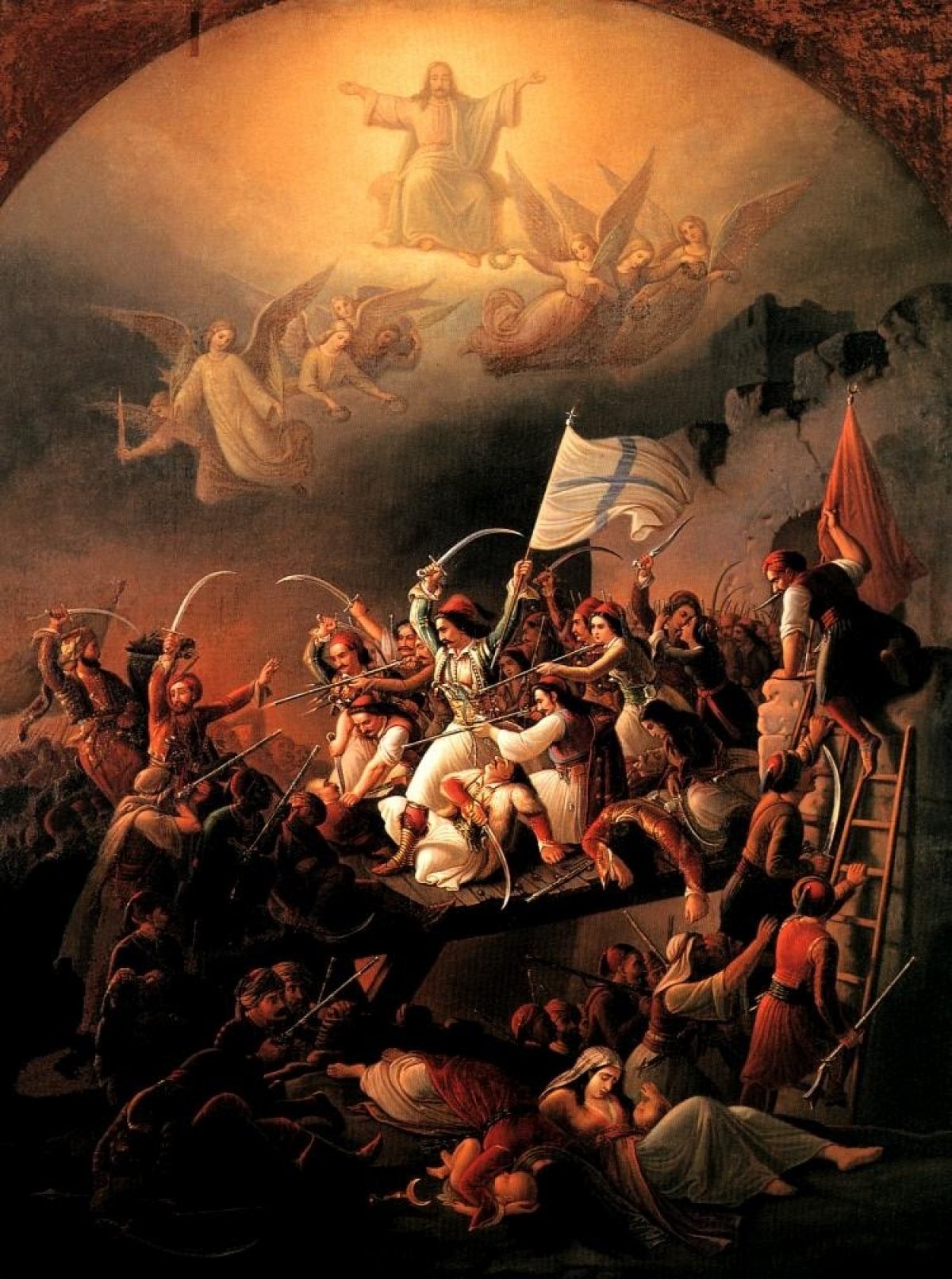

But the Icarian flag had been used before. Greek revolutionarists used it in Macedonia during 1807

And 1821

According to the legend, they used a makeshift flag, from the blue dolman of a priest (Papaflessas) and the fustanella of a warrior (the kilt like white skirt of the Greek Evzone).
In this painting of the Icarian revolution you can see two Greek flags of the time in the foreground and the Icarian flag on the sole warship of the Free State of Icaria, Cleopatra. Also an Othoman flag.

This flag is still used on festivities and parades, with "Free State of Icaria" and 1912 written on it.

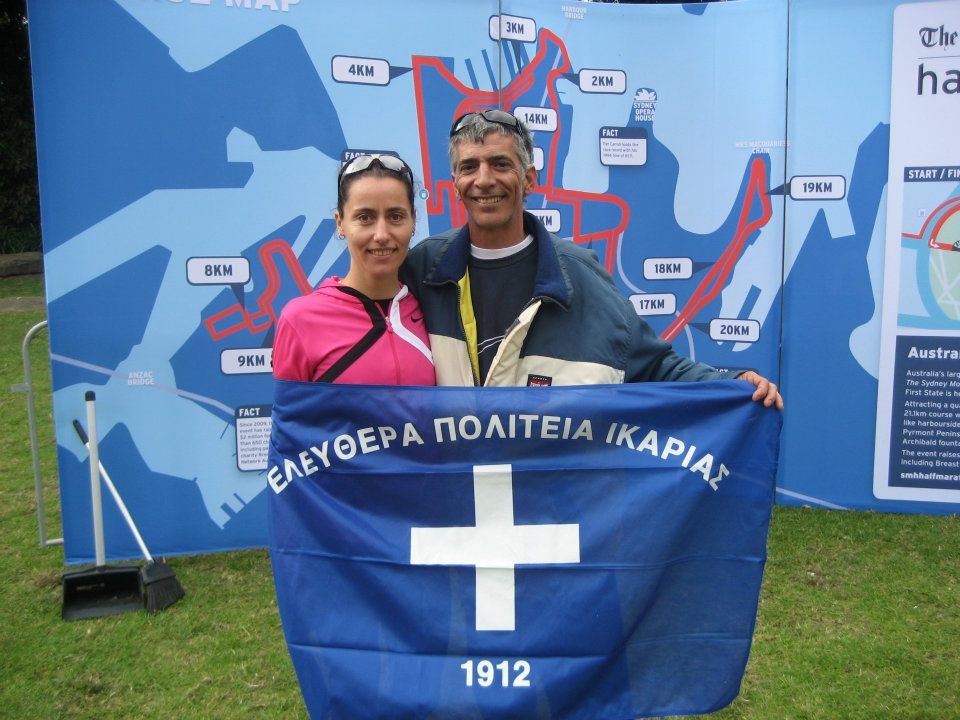
Sometimes the cross is thinner.

They sell T-shirts to turists with the flag.

People are proud of it and you may find it everywhere, in a tavern...

... on old Comicbooks...

... or on the summit of Mt Olympos (were Gods used to live).
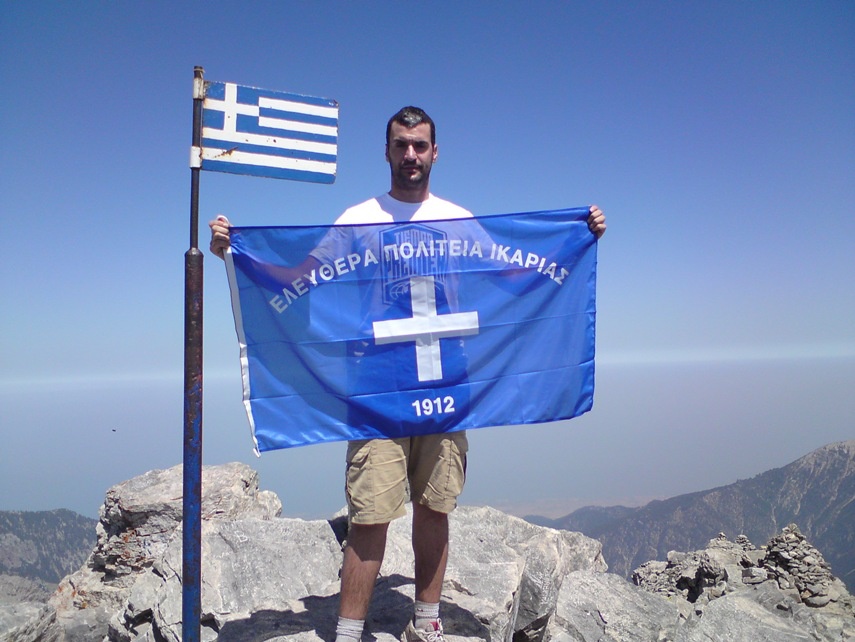
You may see the original flag in a museum...

... and held by revolutionists in a photo of the time.

It was used in the Coat of Arms of the Kingdom of Greece 1833–1923 and 1936–1967...

... and the Second Hellenic Republic, 1924–1935.

It is also used on unofficial flags, like this one, combined with the Byzantine double headed eagle.

Icaria is also worldknown as the place on earth were people live longer and as the "Red Rock" because of the 13000 Communists that were exiled there during political turmoil in the past.
So, if you have any blue SAK with a white Greek cross, it is not a Swiss knife but Icarian knife (although still made in Switzerland).



 Donations
 Community Links